RSS

Category Archives: Education

Finally! They are charging cyber-bully teens

Washington State has set a precedent by charging 11 and 12-year-old kids for cyber bullying.

This is fantastic.  All too often I have heard about kids making others upset writing on Facebook walls, harassing, creating fake profiles, showing and creating unsuitable content on computers, tablets and smartphones.  This isn’t just the boys.  It’s the girls too!  And it isn’t just the older ones.  Students are starting as young as grade 2.

This is definitely an issue that is occurring in schools, but they can’t take full responsibility for the problems.  People, young and old, educators, parents and children need to do something about this problem.

My recommendation is that it doesn’t stop there.  If all countries adopted laws that are not toothless, students will think twice about being inappropriate online. Coming from the top-down takes out the grey area for schools.  A lot of the harassment is taking place at night-time, on weekends, and in the summer time, which is outside of the educational domain.  Is it still suitable for schools to be managing these situations?

We are charting relatively new territory.  However, there is already substantial proof that cyber-bullying is effecting students detrimentally.

Queensland University of Technology (QUT) researcher Marilyn Campbell said many child victims of cyber and internet abuse felt they had no place to hide.

She said cyber bullies were posting personal information about the victim on the internet while letting all their peers know the web address via email.

Dr Campbell said the victim had no method of direct retaliation and could not even strike back physically. She said that there is a feeling that everybody in the peer group knows what’s going on, whereas in face-to-face bullying it’s at least more contained with only a small audience.

More than 13 per cent of students already had fallen victim to cyber-bullying by year eight of school and 25 per cent knew someone who had. More than half of kids thought the phenomenon was on the rise, the study showed.

While traditional bullying often had long-term damaging consequences for its victims, it was possible to surmise that cyber bullying could have even worse consequences, Campbell said.

What if countries and states are not taking control where you live?  What can you do?  This video has a few strategies, including parenting, education and involvement.


Tags: , , , , , , ,

Kids don’t need to take notes in Tech class

This was a web clipping update that Jeff Utecht took “Colorado schools are beginning to write off cursive handwriting” found here at Coetail@Bkk.
I thought the clipping was interesting and also agreed.  In fact, I was just talking with another teacher about how I don’t usually allow students to hand in assignments that are hand written.  I like to read assignments that are typed “10 or 12pt Arial, Helvitica, Garamong or Times, single-spaced, narrow margins, double-sided”.¹  The reason for this is that I like the standard, easy to read font and the lest three traits are to save with paper.²

In my class I most often have students using a digital device to write notes.  More recently I have had a few ingenious [read: crafty or possibly even lazy] students who have asked if they could just take a photo of the board after I have written or typed notes, so just as this title suggests, they are no longer taking notes in my class.

Now that I allow students to be friends with me on Facebook I also often notice that notes, book clippings, photos of the board and many other things pertaining to assignments in classes are turning up as photos on walls.

It’s definitely a different world that we are living in.  I can’t even imagine if I asked my teachers back when I was in high school or elementary school if I could take a photo of the board and how they would have reacted.

As a teacher I can see the benefits of writing the notes.  Writing things down means that we are visually and physically processing all of the information.  Still, due to time constraints I will allow students to take photo notes with their gadgets … AND some actually even seem to refer back to these photos.  Cool.

When all is said and done I don’t think we should throw the baby out with the bath water.  I counter my argument with the fact that everyone will need to pick up a pen or pencil to fill in a form or write something down the old fashioned way.  In these cases, students do need to have knowledge of how to write with their hands.

I ponder this thought about the future, but what will happen to synaptic connections in the brain and also to our hands fine motor skills due to the fact that we are using them less and less for holding a pen?  I know that the art of penmanship has gone out the window, but will there be other consequences?

I think, as with everything, there is a time and a place.  Technology is allowing new and useful ways for students to change their habits.  It is up to the educator to decide in what amounts they will teach or allow certain skills.  I look forward to seeing the next ingenious and crafty strategies my own students bring to class, as it usually brings humor to my day and also makes me think.

¹I also insist upon: Headers with ‘ClassAssignment TitleStudent’s Name‘; Footers with Page Numbers styled bold2 ‘Page 3 of 42‘; the use of Headings and Subheadings to be referenced with a Table of Contents; and a Conservative Title page with an Abstract

²Most of the time I try to have students hand things in digitally through one-note, a wiki, a Ning, or through Google Docs.


Tags: , , ,

Do teachers have right to their intellectual property?

I had a discussion the other day with a teacher about the idea of a teacher’s intellectual property.  In most teacher’s contracts, in almost every school, they state that anything that is made or created by a teacher during the time of employment becomes the property of said school, school board, or business.

Atlas Rubicon is a system many schools are adopting to consolidate these properties.  It seems like a fantastic idea:  Teachers put their curriculum, lessons, notes, Powerpoints, and any other digital materials into the system for others to use.  Not only do the teachers at the school have access to the lessons of others, but other schools who have signed up through Rubicon also have access to everyone else’s property.  Über-cool!

The drawbacks, however, were also part of this discussion.  One, is the fact that schools could use this system to weed out expensive (older) teachers.  They might ask these teachers to allocate their resources onto these servers and then ‘let them go’ in the future, in order to hire younger, cheaper teachers to replace them.  How is this affecting students?  Are they getting the best education they can?

I guess my argument against that is that schools and administrators would hopefully not base their hiring and firing practices on salary amounts, but on effectiveness of teachers regardless of their age.  But sometimes there is a bottom line.  My colleague countered this mentioning that international schools most often do not hire people over 60 years of age. Yikes.

Another con to Rubicon is the fact that they are the holder of all the digital knowledge, AND they are charging education systems a fee to subscribe.  This means that they have a monopoly on the information that we, as educators, hold dear and true to ourselves.  This means Rubicon could start to charge outlandish prices for something that we need and also created.  Hmmm…What are the safeguards that Rubicon won’t be unethical in pricing?

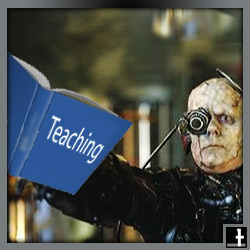
I really like the idea of being able to tap into every other teachers ideas, but I don’t like the chance of losing my own right to this property.  It is almost as if I am being assimilated into the Borg.  At what point does something that I create become completely my own?  Teachers usually work from contract to contract.  Does that mean that nothing they make until they retire actually belongs to them?  As a teacher I need to consider my future carefully.


Tags: , , , ,

Cheap ways to master the universe

These are some ways that I am planning to master the universe.  You can steal, borrow, appropriate and copy any that you see fit.  A couple things seem to be in my future:

  • a book – most probably an ebook – coming soon – gonna read more about some ideas for marketing it here from Seth Godin’s “Ideavirus” (a free book that you can buy – I might try this myself – you should too)
  • a domain name – toying with a “.me” as the suffix and have a pretty good idea what it will be called.  I will get it from godaddy.com as they seem to have worked well in the past for domain name forwarding.¹
  • logging, creating, showcasing more of my artistry – I am good.  I have good ideas.  I actually was allowed into OCAD for 5 years because they thought so too.  I will probably do that starting right here on the site with some of the logos and designs I have made with hopefully a lot more to come
  • working through education towards working anywhere, any time, and most probably about any thing – I don’t want to be limited by any of the aforementioned factors: place, time, confines of job description, so I am plotting ways to do this – one way is hopefully through developing online resources
  • (slick) business cards – gotta have em – plus you can feel cool giving them out – ooh, and designing them.

¹ Since writing this post I have created this blog through WordPress.com.  It allows you to buy and link a domain name really easily to your site.  The drawbacks are that you do not have complete control over the look and addition of plug-ins or widgets.  The advantages are that you will probably get higher hits to your blog sooner, it is all-in-one, which means it is easier, and you have support from WordPress.com.  This is something I did not find with Orgfree.com.  Too bad.


Tags: , ,