RSS

Tag Archives: Technology

Image

14,000 hits

14,000 hits

Woohoo!!  I remember when I was going on 1000 hits.  It was an exciting time.  Now, I have been blogging, tweeting, Scoop.iting, Scribding, Youtubing, Linkedining, and connecting for a few years now.  I just looked down and noticed my hit count.  Pretty cool.  I (we: Pla and I) are about to hit 14,000 hits for the site.  This is an exciting time.

I am nearly half way through my PhD, which definitely slows down the blogging process, but my next goal will probably be to write a few books.  Keep coming back.  I try to add content that is interesting and useful to any educator.

Cheers and thanks for popping by.
Tom Johnson and Pla Sankhum


Tags: , , , , , ,

Tech Integration Response to Email Questions

brass_integrator

brass_integrator (Photo credit: xmatt)

A recent group of colleagues, tech integrators from around the world, have recently connected through email contact.  One of the cohort posed a few questions, “[I am} interested in Tech lesson ideas for PK – Grade 5.  Also how you’re day is spent integrating technology in your schools. If you teach classes or are full time integration.”

I thought I would share my response here:

Hello,

I am going to try to get back to you about specific tech ideas because there are so many.  Our team is presently developing a website to showcase tech integration ideas using 3 New Literacies: Community, Tools, and Information.  This is being developed for PYP, MYP, and DP.  When it is populated I am eager to share it.  For now, I will point you to the Florida Tech Matrix: http://fcit.usf.edu/matrix/

Concerning how the day spent as a tech integrator, it is interesting to compare this year to others.  Essentially as a tech integrator, and as John D’Arcy puts it, we are working our way out of a job and into a learning coach role who spends more time researching and promoting learning theory and practices.  However, teachers will usually need help learning new tools.  Jeff Utecht states, “We are in perpetual beta”.  The way he explains this idea is that online and offline programs and operating systems are continually updating and upgrading.  This means that we never really become experts because a version with all new bells and whistles keeps us and other teachers on their toes.  This is the reason I know we will always have a job as researchers, testers, implementers, and promoters.

As a tech integrator, originally I was working in classes in the capacity as a lead-teacher, co-teacher, or support teacher depending upon what the teacher needed and specified.  More recently I am finding that I am working much more with teachers individually who have lists of questions they would like answered.  I work with them on a weekly basis and help them with everything from blogging, to email and Google Drive organization, to SMARTboarding, to iPad app exploration, and so much more.  They are figuring out and adapting lessons from previous years but still ask for my help once in a while.  I write more about the idea of tech integration here: https://ict-design.org/2011/09/02/technology-integration-a-six-pronged-approach/ and share Keengwe, J., & Onchwari, G.’s (2009) tech integration rubric here: https://ict-design.org/2011/10/25/technology-integration-rubric

With regards to your last query, I am a full-time tech integrator with an open schedule.  I use and share my Google Calendar with staff here: https://ict-design.org/make-appointment  I found that if teachers were able to edit my calendar I would have some of them coming up to me at the end of the day saying, “You didn’t come visit my class” because I missed an appointment they made minutes before the due time.  Therefore, I make my calendar read-only, which means they need confirmation from me about appointment details.  It seems to work much better.

Hope that helps.
Thomas Johnson
Technology Integration Specialist | Learning Coach


Tags: , , , , , , ,

K.I.S.S.

If you don’t know what K.I.S.S. is an acronym for, it’s time to look it up here at Wikipedia.  Subject to that idea, I would like to comment on Keeping It Simple.  I assume that one of the reasons that Apple and Google have done so well is because they got rid of all the bells and whistles and made things clean.  Just thinking to myself the big difference between the two aforementioned companies versus the likes of Microsoft, Yahoo or AOL and I would state its clutter, or lack thereof.

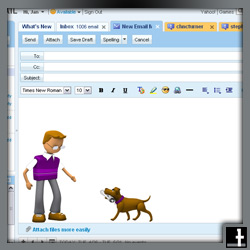
A friend of mine came in to me today asking how to get rid of the “stupid dog” that is now on the Yahoo email message.  Something that was never there before has now appeared and it took some looking around to figure out how to remove a silly image that a grown man probably doesn’t want to send as part of all his emails.

To that degree, let’s talk about movies.  And by movies I actually mean the blockbusters.  What are most of the blockbusters coming out in?

You got it: 3D

I’m not sure about you, but after the first or second time, movies in 3D are not a thrill for me anymore.  In fact, I actually don’t like them.  But sometimes the 3D movie might be the only one that is available, or is the next available film.  What am I do to about this?  Why haven’t they kept it simple, stupid?  Now, to some relief there are glasses that turn 3D movies into 2D.  Woot!   Here’s how they work:

When you watch a 3D movie, there are actually two images being projected onto the screen. That’s why the screen is blurry when you look at it without glasses. In 3D glasses one of the lenses blocks one image and the other lens blocks the other image.

Thus, when you watch a 3D movie each of your eyes is seeing a slightly different image. Your brain combines those images together, creating the illusion of a 3D image.

2D Glasses block the same image with both lenses, so each eye gets the same picture resulting in a 2D image and an elimination of eyeball strain.


Tags: , , ,

Technology Integration Specialist – job descriptions

International Conference for the Integration o...

As a technology integration specialist (TIS) my job description is all over the place.  I was in a meeting today where the principal of the school, who has been doing interviews with teachers to find their needs, has come to the conclusion that teachers have very specific needs, and so do their classes.  I agree and am glad he gathered this evidence to support what I was thinking.

What does this mean then for a TIS?

The first thing that it seems to mean is communication is needed on the part of the TIS.  As a TIS, we need to explain:  What is it that we are doing?  Where are we?  How can we be contacted or booked?  What types of things can we bring to the class?  What types of systems are we putting in to place? and the list goes on…

What kinds of strategies can we put into place?

  • Walking from classroom to classroom – trying to drop in to the classrooms that have the computers out with their kids.  And dropping in to the classrooms where SMARTboards are being used…or dropping in to classrooms where no tech is being offered, to get a sense of the units.
  • Being available at certain times in specific locations – this could rotate through the week.  For example, Week 1: Mon – Fri 12:30 – 1:00 in an available room, like a Science room or computer lab, Week 2: Mon – Fri 9:00 – 9:30 in an available room, and so on.
  • Offering as much PD as possible – lunches, after school.
  • Being at everyone’s beck and call – Offering phone numbers to teachers who can call when it is necessary to come down to trouble shoot a problem.
  • Offering kids available times to meet – lunches or after school should suffice.
  • Designing new policies – For example, Facebook and online social policies.
  • Setting up infrastructures.  For example, Google Docs and Dropbox for communication and collaboration, Netvibes for organizing life, booking systems, saving and cloud systems, infrastructures for instruction online and more.
  • Tweeting great sites and strategies.
  • Blogging about what we are doing.
  • Creating websites or resources for teachers who need it.
  • Researching and learning about all the latest trends or immediate tech that is necessary.
  • Being friendly and approachable by everyone.

But is this enough?

As a TIS, this probably means that many hats are to be worn.  For example, TISers might be on committees about websites, or technology in general.  They might be trying to do overarching projects, like developing larger PD or workshops, or building community relations with other schools and their tech and media departments.  They might be inundated with emails every day, but it is their job to set an example, to reply to each and every question, query, statement, request, reply, and quandary.

They should realize they are lucky. This is because they have the opportunity to continually better themselves while they are helping others.  In walking into every classroom, they get to see what other teachers and classes are doing and glean or appropriate (read: steal) ideas from their coworkers and friends.  Because of this, they are continually learning and growing and able to offer more to their fellow workers and student body.

As a TIS, its great to be loved and needed.  It is just too bad there aren’t more ways we can split our time or add more hours to the day.  I am sure as an educator or a human I am not the only one who feels this, but it would be great.  Maybe this is one more system we need to design. 🙂


Tags: , , , , , , , , , , ,