Regarding the article, “The Flight from Conversation”, I would argue against Turkle’s (2012) endorsement that, “My students tell me about an important new skill: it involves maintaining eye contact with someone while you text someone else; it’s hard, but it can be done.” Wouldn’t the important new skill be putting the device away and paying attention to the person with whom you are making eye contact?
But things get worse (better?). Right now smart phone devices are only handheld; however, Google is planning to release Google Glass to the public in 2014. Jeff Utecht just said last week at the ECIS 2013 conference that some students at Singapore American School already have it. Wow. Cool. Really?
As educators, Utecht points out we need to ask ourselves, “How is this Google Glass device and ones like it going to change the way I do things in my classroom?” Our natural responses to most new technologies is to ban it. However, will this be the best solution for something that is so powerful and will continue to change the way we do business in school. How do we ban something that eventually doesn’t look like Google glass, but only like a pair of reading glasses? This will happen as technologies get smaller and smaller. How do we ban technologies when they are planted directly into humans and are interfacing with the brain? Utecht posits this to be around the corner as well.
How do we start to work towards this future?
As an educator, starting Monday, if you are not doing this already, stop teaching the stuff that is “Googleable” (McIntosh, 2013), “Wikipediaable”, “Wolfram-Alphaable”, “Khan Academyable”, “Youtubeable”, and “MOOCable”. As McIntosh explains in the previous link, put a board on your wall in the classroom: “Googleable” and “Not Googleable” questions. When students ask the former type of question, ask them to write the inquiry down on a sticky note and post it on that board. Inform the student they need to find that answer and come back to the class with the response. This is where the iPhone 5Ss, Galaxy S4s, HTC Ones, and dare I say, Google Glasses will come in handy. We, as educators, can have students use these devices to our advantage. For the other types of questions, the “Not Googleables”, let’s write those questions down too, post them on the wall, and delve into them. They are deep. They need conversation, guidance, and debate.
However, I digress, the article was about the dystopian future, like the one illustrated in the movie Wall-e. We are becoming disconnected in real life as we become connected to the ‘people cloud’. If you have ever watched Star-Trek, we are becoming the Borg – lifeless, robot-like humans, who are getting assimilated into “the hive”.
So the bigger question is “how do we battle this?”
I would argue that my job description in the near future will turn from “tech integrator” to “tech disintegrator”. We are adopting and adapting technology at an exponential rate. We need to step back and start having talks about “How much is too much?” and “How do we manage these devices and the disconnections they are creating in everyday life?” We need to model real-life connection when we are in life. We also might need to start calling a spade a spade. By this, I mean, we need to ask our colleagues, friends, family, and lovers to put down the device and be with us. At the same time, we need to be ready to do the same when someone says this to us.
I love the ideas that Turkle puts forth, which are “At home, we can create sacred spaces: the kitchen, the dining room. We can make our cars “device-free zones.” We can demonstrate the value of conversation to our children. And we can do the same thing at work. There we are so busy communicating that we often don’t have time to talk to one another about what really matters. Employees asked for casual Fridays; perhaps managers should introduce conversational Thursdays.”
For those with less will-power, we can start by putting limits for ourselves on devices and internet.
Try scheduling your router:
For controlling kids devices, try something like this:
We shouldn’t need this, but some of us do. This brings me back to my original argument, which was that the new skill is not learning how to make eye contact while testing to someone else, but it is having the will-power to put the device away while you are with your loved ones, your family, your friends, your colleagues, and having the courage to put it away when you are only with your self.
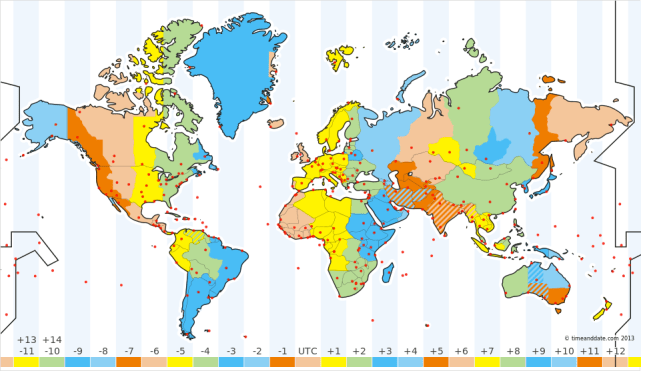
One of the projects on the back of my mind for our school is to buddy different classes or grades with “sister school” throughout the world. Where this most often becomes is through technology, authentic needs and projects, and through meeting synchronously at the same time. To alleviate this last worry, I was examining the idea to limit the schools we would connect with to those within our own timezone (for now).
Time Zones
This would mean that we could still get a cross-cultural feel for how things are in different parts of the world, but never have mix-ups or hiccups because of timing. I can envision it now:
“Ok, great. We’ll Skype with your class at 2pm then.”
“Wait, 2pm your time or mine?”
“Oh, ours.”
“Oh, we will already be gone home.”
This preplanning could fix all of this hassle down the road. Because I am in Istanbul, this gives me a wide gamut of places and schools to consider, for example, Finland, Kiev, Bucharest, Cairo, Lubumbashi, Pretoria, Cape Town, and the list goes on.
Asynchronous conversations would end this worry and could be done through ideas like: Edmodo, Wikis, Blogging, Google Docs, Twitter, Twijector, and more. However, there is definitely something about connecting in real-time. I am excited about the idea and will comment further about the progress and the new problems we may face.
Did you know that Facebook and Google were filtering the results you get? It’s true. This means that results you get may be completely different from results that your friends, your neighbors, your adversaries, people of different ages, different demographics, different locales and countries get. This is a scary thought to me.
Essentially what is happening: If I am a right-wing or left-wing person who only searches for right-wing or left-wing ideas, this is what I will find. This is what will be presented to me. This is what is reinforced in me as: Truth. I take that idea back that ‘this is scary to me’ and want to replace it with: THIS IS TERRIFYING TO ME!!
Proof:
Watch this video to understand more:
Strategy:
I am not going to repost this post from The Filter Bubble, but they explain main ideas for how to combat search result filtering:
Burn your cookies.
Erase your web history.
Tell Facebook to keep your data private.
Hide your birthday.
Turn off targeted ads, and tell the stalking sneakers to buzz off.
Go incognito.
Or better yet, go anonymous.
Depersonalize your browser.
Tell Google and Facebook to make it easier to see and control your filters.
Tell Congress you care.
I would add:
Compare friend results – like you saw in the video
Network through places like Twitter around the world and ask to compare results from people outside of your sphere of thinking – Try to think what you search for and like and choose the opposite #tag instead – for example, if you are a Republican and always search #Republican, try #Democrat instead, and vice versa. If you search #Vanilla, try #Chocolate. Connect with new people from the other side of your views, your searches, and your beliefs.
Start searching things you don’t normally search – Try to trick these algorithms. (I don’t know if this is possible, but it’s worth a try)
Taylor made is good, but not always. I hope you take action to see what you might be missing.




 education | technology | ai & NOT A.I. | design