 I had a discussion the other day with a teacher about the idea of a teacher’s intellectual property. In most teacher’s contracts, in almost every school, they state that anything that is made or created by a teacher during the time of employment becomes the property of said school, school board, or business.
Atlas Rubicon is a system many schools are adopting to consolidate these properties. It seems like a fantastic idea: Teachers put their curriculum, lessons, notes, Powerpoints, and any other digital materials into the system for others to use. Not only do the teachers at the school have access to the lessons of others, but other schools who have signed up through Rubicon also have access to everyone else’s property. Über-cool!
The drawbacks, however, were also part of this discussion. One, is the fact that schools could use this system to weed out expensive (older) teachers. They might ask these teachers to allocate their resources onto these servers and then ‘let them go’ in the future, in order to hire younger, cheaper teachers to replace them. How is this affecting students? Are they getting the best education they can?
I guess my argument against that is that schools and administrators would hopefully not base their hiring and firing practices on salary amounts, but on effectiveness of teachers regardless of their age. But sometimes there is a bottom line. My colleague countered this mentioning that international schools most often do not hire people over 60 years of age. Yikes.
Another con to Rubicon is the fact that they are the holder of all the digital knowledge, AND they are charging education systems a fee to subscribe. This means that they have a monopoly on the information that we, as educators, hold dear and true to ourselves. This means Rubicon could start to charge outlandish prices for something that we need and also created. Hmmm…What are the safeguards that Rubicon won’t be unethical in pricing?
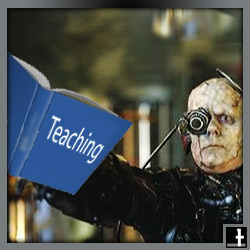
I really like the idea of being able to tap into every other teachers ideas, but I don’t like the chance of losing my own right to this property. It is almost as if I am being assimilated into the Borg. At what point does something that I create become completely my own? Teachers usually work from contract to contract. Does that mean that nothing they make until they retire actually belongs to them? As a teacher I need to consider my future carefully.
 The “Like” button.
 When we ask this question the first thing that pops to my mind is: “Do I have a mobile device, like a cell phone, PDA, tablet or computer with wifi?”
 WordPress.com has a Poll creator. I would not say that it is very intuitive considering it is built into the interface. The downside is that the poll itself is not embedded in WordPress, nor are the results. If I figure out a way to do that I will be updating this post to show you.


 education | technology | ai & NOT A.I. | design