RSS

Category Archives: Education

2 Reasons why I love Infographics

Attention: 

If you don’t know what infographics are, it’s about time you learned.

If you are a teacher and you don’t know what these are, it’s about time you started getting your students to use and create them. 

Infographics, also known as information graphics are: The picture worth more than a thousand words¹.

Wikipedia presently states an infographic is a “graphic visual representations of information, data or knowledge’.

But why are they important to harness and use?

Proof:

You have probably come across a few infographics in your life: Subway route systems, weather maps, and even the common red octagonal stop sign, which is a simple form of an infographic.  Below, I have listed the importance and reasons why I love infographics:

  • Graphics are universal, meaning they are easily understood across cultures.
    If you have traveled to a non-English-speaking country, think of a time you have tried to read signs to figure out what they mean.  If you were in a Spanish-speaking country this was possibly easier than if you were in China or Thailand where not only the words, but also the script is completely unintelligible to you.  However, many of these countries have used the idea of infographics to convey meaning to those who need it.  Think of the red octagonal sign with the gibberish script on it.  Placed at a corner, an English-speaking driver of a car still should inherently know to stop.  Just as they might understand the squiggly lines on a yellow sign might mean a curvy road up ahead.  The graphic does more for the international user than any word in any language ever could.
  • Complex information is displayed visually to appeal to this type of intelligence.
    Howard Gardner explains those having Spacial/Visual intelligences as “having visual and spatial perception.  [They are able to] interpret and create visual images.  [They have] pictorial imagination and expression [and] understand relationship[s] between images and meanings, and between space and effect.” http://www.businessballs.com/howardgardnermultipleintelligences.htm
    I feel this is my primary type of intelligence.

We understand why we might want to use or create infographics and for who, but how?

Strategy:

  1. Determine topic of the infographic.
  2. Research data needed to display.
  3. Decide on color scheme.
  4. Design infographic and keep it simple.
  5. Try: Graphs, Timelines, Flowcharts, Size Comparisons, Venn Diagrams, Annotated Pictures and Maps
  6. To create graphics use:

Go Beyond: Use Adobe Photoshop, Illustrator, Fireworks, 3D Studio Max or any free available graphic design software like:

Find more graphic design tools at snap2objects blog here.
See a step-by-step guide to creating an infographic using Adobe Illustrator here at vector.tutsplus.com
See a few website examples of infographics here, here, here, and here.

¹ Coined by Thomas Adam Johnson Monday, June 13th, 2011
 

Tags: , , , , , , , ,

Sneak Peak: End of the Year Video

Attention: 

For those of you who would like a sneak peek at the end of the year video I made for the MYP kids at Concordian International School, this blog post is the embedded video and link to it.

Proof:


Strategy:

Want to make one yourself?

  • Subscribe to Animoto
  • Upload, or choose pics/video from your computer or even Facebook
  • Choose some music – Animoto has lots of nice stuff, but you can upload your own
  • Choose the theme and transitions
  • If you would like longer than 30 second videos, you need to pay $5.00
  • Download high quality videos for $3.00 per video
  • Use Freemake Video Converter to edit, change formats, and add images

I was using Adobe Premier, but with all its bells and whistles I wanted to use something a lot simpler.  Freemake definitely does everything I needed and the quality seemed better than what Adobe was giving me.  Freemake feels like early versions of iMovie that were easy to use with an easy learning curve.  Try it yourself to see what I mean.  Good luck and happy video making.

  • A great plugin for Firefox is called netvideohunter which allows you to download videos directly from Facebook, Youtube and many other sites.
 

Tags: , , , , , , , , ,

If you are a teacher this is how your Facebook settings should be

Attention:

Facebook needs the default privacy settings I have listed below.

Aside to this fact, I have an ongoing argument with a good friend of mine about teachers adding students to their Facebook accounts.  My friend feels teachers should not add students because students might see something not meant for them.

I am this wary about anything I put on to the internet.  As an educator I do not want anything on the world-wide web from or about me that is anything less than professional.  Why are the comments, photos or other things I put on to Facebook any different?

Essentially, if someone who I added as a friend wanted to place my images or text in some other forum they could easily do so.  No one should consider Facebook a secure environment to treat as a secret diary.

Nonetheless, there are some major uses for Facebook in education.

Proof:

Patrick Batty has this to say about Facebook in education:

[M]any students, instructors and administrators are using a number of Facebook applications for a wide variety of academic purposes.

Recently we’ve been examining a number of Facebook apps that are relevant for educational use. We’ve assembled a small list of 20 facebook apps here and are happy to have others add additional apps to the list that you’ve found helpful.

  • Books iRead: Share the books you’re reading, and see what others think of books with this application.
  • Flashcards: With this application, you can create flash cards to help you study on Facebook.
  • SkoolPool: Get the lowdown on schools, online and otherwise, with this neat application.
  • Rate My Professors: Find out what other students think of professors before you register for their class.
  • BookTag: This app offers a great way to share and loan books out to students, plus create helpful quizzes for studying.
  • DoResearch4me: This app makes it easy to gather information using your thesis statement, instructions, and more.
  • Mathematical Formulas: Distribute formulas, solutions, and more with this application.
  • SlideShare: Create presentations to send to students with this slideshow application.
  • Calendar: This calendar app from 30 Boxes lets you organize your days, set reminders and share your calendar with others.
  • To-Do List: Stay on top of your tasks with this Facebook to-do application.
  • Zoho Online Office: You can keep all of your documents online, and even share them with classmates, students, and colleagues.
  • UdutuTeach: UdutuTeach allows you to import courses from myUdutu (a course authoring tool) manage which people can take your courses, and track the learners’ progress.
  • UdutuLearn: UdutuLearn lets you view courses that you have been given access to and shows your progress.
  • Courses: Courses offers loads of functionality for online education, with features that let you add your courses, post announcements and assignments, search university reviews find classmates, create discussions and form study groups.
  • Files: Powered by Box.net, this application makes it easy to store and retrieve documents in Facebook, so you can access them anywhere you have a connection.
  • WorldCat: Use WorldCat to do research, catalog your library’s collection, and share information with students.
  • HeyMath!: These mini-movies explain difficult math concepts, so these are great to share with students or use on your own.
  • Study Groups: Get everyone together on your group project by collaborating with this application.

Caroline Lego Muñoz of Fairleigh Dickinson University states, “Facebook is equipped with bulletin boards, instant messaging, email, and the ability to post videos and pictures. Most notably, anyone can post information and collaborate within the system. Recently, Facebook has opened up development of downloadable applications, which can further supplement the educational functions of Facebook.” in the essay, Opening Facebook: How to Use Facebook in the College Classroom.

I try to take the early adoption technique about new technologies and implementation of such.  If you want to as well, try the following.

Strategy:

Follow these 19 steps.  This will take 1/2 hour to an hour.

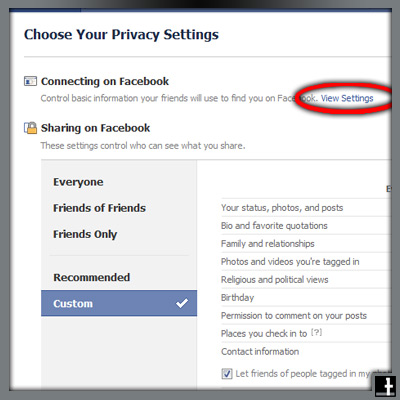
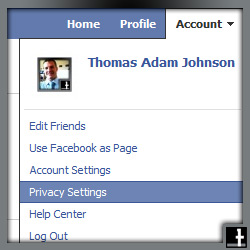
  • Choose Privacy Settings in the top-right corner, like you see in the picture below.

  • Click on View Settings

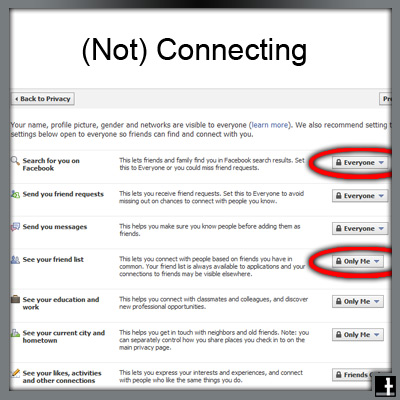
  • Change the Search for you on Facebook setting if you do not want everyone to find you
  • Definitely change the See your friends list.  I set mine solely to myself.
    [Side-note: Last night, at a staff party, a colleague of mine was wondering why students I had added as friends were not trying to add her.  She said the students all asked if she was on Facebook, as they wanted to add her.  She thought the students were a little slow, but then I mentioned I don’t allow others to see my friends list.  She thanked me.]

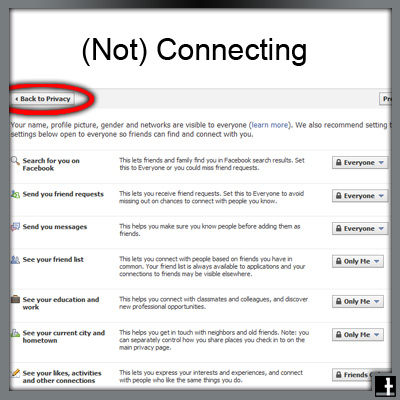
  • After you have changed those settings, go Back to Privacy

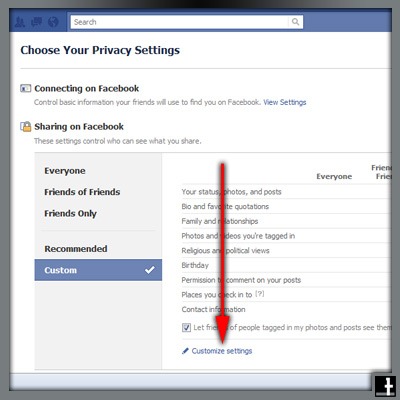
  • Choose Customize Settings

  • Assuming you consider what you write when you post, you shouldn’t need to limit the Posts by me for your friends – who may be students.
  • Consider your Relationships, Interested In, and Religious and political views as private
  • Take note: You can edit Privacy Settings for Photo Albums and Videos here

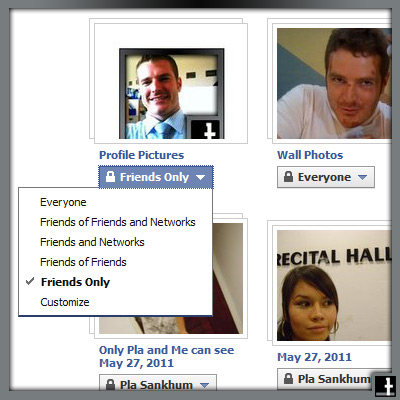
  • When you Edit privacy settings for photo albums, you have the options seen below.
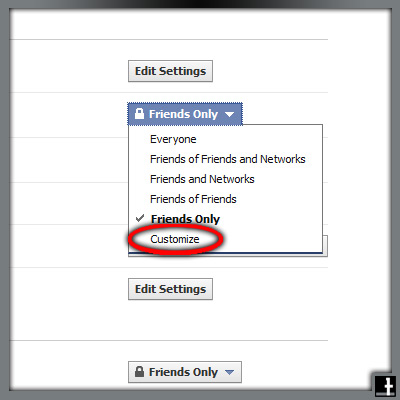
  • If you only want specific people to see, choose Customize

IMPORTANT:
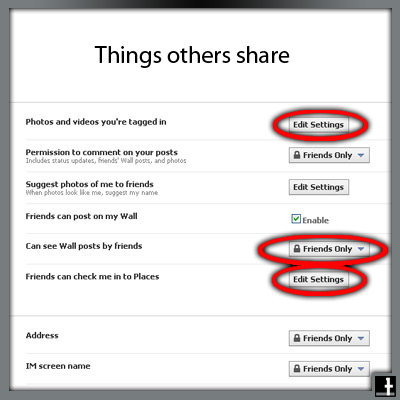
You want to limit what others post about you

  • Choose Edit Settings for:
  • Photos and Videos you’re tagged in
  • Can see wall posts by friends, and
  • Friends can check me in to places (You never know where someone might check you in)

  • Choose Customize

  • Choose Specific People
  • This will take a while – You need to go through your friends list and choose who can see.  I usually start typing “a” and Facebook auto-completes with friends with an “a” in their name.  Then I type “b”, then “c”, and so on, up to “z”.

Good luck.  Report back if you think I missed something or if you would do it differently.  Cheers.


Tags: , , , , , ,

A website worth featuring

Attention:

I don’t do this often, but the Academic Earth website it definitely worth featuring.  The website features videos from some of the best educational courses the world has to offer.  For example lectures from: Berkley, Columbia, Harvard, Khan Academy, Maryland, Michigan. MIT, Norwich, NYU, Princeton, Stanford, UCLA, UNSW, UCS and Yale are all embedded within it.

The site is simple, intuitive and to the point.  Videos load quick as they are often embedded directly through Youtube.

Proof:

I am not going to get into the debate about whether education is good for you or not.

However, I am going to point you to a study that actually says that online learning could be better than learning in a classroom.  The study is called Evaluation of Evidence-Based Practices in Online Learning.  It is summed up well in this article by the New York Times.

The Bakers Guide also supports this theory.  Alas, they are an online learning community and could therefore be viewing their evidence with a bias.

Whichever way the debate goes, you can’t go wrong with watching a view videos from the Academic Earth for educational growth, as opposed to the latest on the television.  So what can you do?

Strategy:

  • Save Money. Instead of spending thousands of dollars for courses that you would like to take, go to the Academic Earth website and view the best of the best
  • Search by Subject
  • Search by Top Rated Instructors
  • Search by Top Rated Lectures
  • Search by Top Rated Courses
  • Search by Top Rated Playlists
  • Read more about online free learning here
 

Tags: , , , , , ,