Dr. THOMAS JOHNSON
-intrapreneur, practicing academic, learning coach, designer, technology integration specialist, and educator
-has lived in: Canada, Guatemala, Taiwan, Thailand, Turkey, and China
-loves: Skiing, Sushi, Badminton, Volleyball, Working Out, Contemporary Art, Clean Lines, Good Food, Great Music, People Watching, Exploring, and his Wife, Son, and Daughter.
All three devices are moving away from the touch keyboard the way we know it. As I mentioned in the Bento Box article, I like the tactile feel of a nice keyboard, but I was sitting in an ISTEC meeting the other day taking notes on my iPad with the touchscreen keyboard, and I felt this was something I could get used to. This would especially be true if it was not something that I was brought up with.
I was talking with a PYP computer teacher the other day and she was saying that little kids seem to have a much faster learning curve on an iPad versus computers with a traditional mouse and keyboard. This idea led me to thinking about a question posed at the ISTEC meeting, “What are fundamental skills that all students should have by the time they graduate from high-school?” and a group member thought one part of the answer was “touch typing skills”
I wonder if this will actually be a skill set in the future. I guess we will have to just wait and see. In the meantime, I can’t wait to add more new gadgets that make my jaws drop when I see them to this list. Enjoy the earlier jumps and the following video.
Less than 2 minutes is all it took me to make the above comic strip. The learning curve using stripgenerator.com is low. The options are seemingly endless. The ability for teachers to use this in their classroom at a low age is high. There is a “like” factor for kids. Why not explore it for yourself. I have listed some of the abilities with this all-in-one website below.
Strip Generator allows for different types of:
frames
characters (plus you can build your own)
items (like tvs, hats, books, toys, instruments and so much more)
text (and text bubbles)
Everything can:
be rotated
be re-sized
be arranged front to back
blurred
have its opacity changed
When you finish you can tag, print, share on Facebook and Twitter, embed on your website or blog, or even join with other strips you have made to create a booklet. The website is very intuitive. I can see many uses for it in education and give it 5 out of 5 stars as a resource.
The reason I mention the preceding internet memes is because I feel like I have found an excellent resource within a resource which these are just a glimpse of.
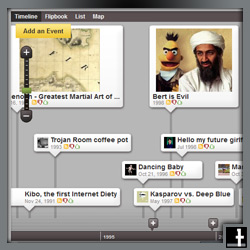
The first resource is www.dipity.com. It is a website that is made for creating timelines and its easy. Its social, which means that you can follow other people, recommend them, and comment on their timelines.
Within that resource is a timeline created by tatercakes that goes much more in depth about internet memes than what I have done. As a technology teacher, I think it is really neat and useful timeline. It has been viewed 4309304 times and can be found here.
Go beyond just viewing tatercakes timeline. Search for others that might interest you. Be a part of the web and create your own timeline for others to share, recommend and comment on. Possibly your timeline might become the next internet meme that tatercakes will be adding to his timeline in the future. 🙂
I was recently in a forum where Berno Nilssonasked asked the question, “What do you think about online learning?”
My response was:
I believe that online learning is a growing educational forum. I feel that all educators need to consider this as something that is not an alternative but is considered necessary integration in education. Students today are living online. We need to meet them in the arena they know best.
Judith Hammock, another responder, wrote:
I believe that online distance learning will continue to build momentum in the future. It brings education to students who do not have access to colleges and universities and provides them opportunities they never had before. Online teaching, to me, requires some special skills. These include the ability to show your enthusiasm for your subject matter through writing, good organizational skills, and the ability to engage your students without your physical presence.
Having had experience with online learning both with teaching and as a student, I feel that the best instructors provide a caring atmosphere which keeps the students engaged.
Conversely there is the argument that online learning takes away from the personal, humanness that we should nurture as we grow. We need to tread slowly in this journey into the digital. For example C. L. Max Nikias writes:
…between the ages of 17 and 22, a person’s mind and spirit open wide, as she begins to explore her world, her place in it, and what she intends to contribute to her society. It is during this age that some of a person’s most intense bonds and affiliations take shape. Because of this, the best undergraduate college or university education should be experienced in community, so that shared social, athletic and cultural experiences can be as mutually transforming as the intellectual experiences inside the classroom, library or laboratory.
My argument is also that online learning does not need to be separate from learning at school, especially in earlier years. Teachers should be guiding students through ways to learn online. I have a blog post that talks about Searching beyond Google and a page that Explores ways to Collaborate Online.


 I was recently in a forum where Berno Nilssonasked asked the question, “What do you think about online learning?”


 education | technology | ai & NOT A.I. | design